
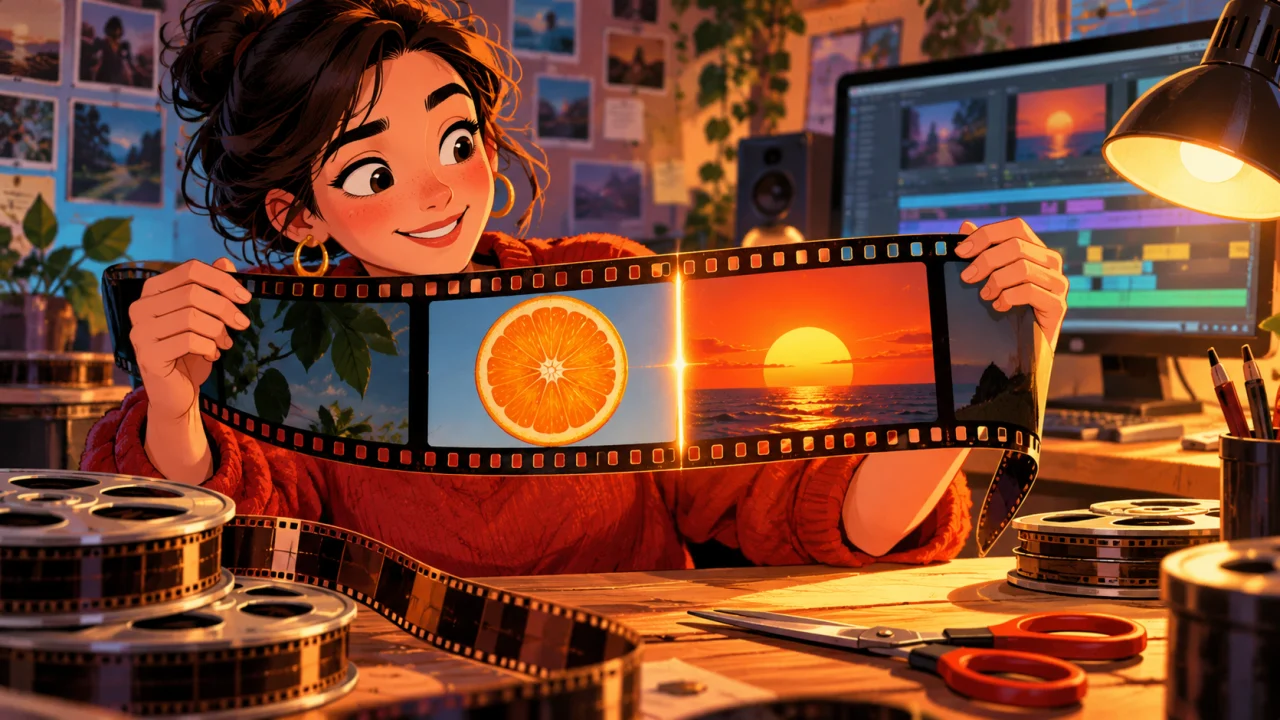
You've probably felt a match cut before you could name one: a scene jumps somewhere completely new, yet the edit feels smooth instead of jarring. So what is a match cut? It's a cut between two different shots that share a strong visual, motion or audio element, so your eye and ear carry straight across the edit. The shared element does the storytelling, linking places, times or ideas without a word of explanation.
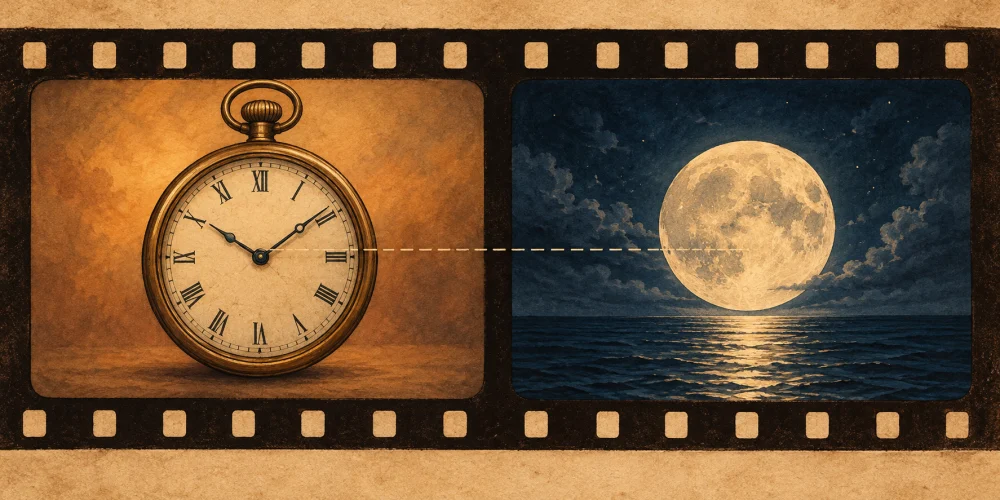
Definition: A match cut is an edit that connects two shots through a shared element (a shape, an action, a sound or a word) placed so the transition reads as continuous. Editors use it to bridge locations, leap through time or suggest a metaphor without dialogue.
Key takeaways
- A match cut is defined by what is repeated across the cut, not by the subject of either shot.
- The four common types are graphic, action (movement), sound and text (typographic).
- Several "famous match cuts" are technically match dissolves: the images overlap for a moment instead of switching on a single frame.
- The best match cuts are planned before you shoot, because position, scale and screen direction have to line up.
What is a match cut in film?
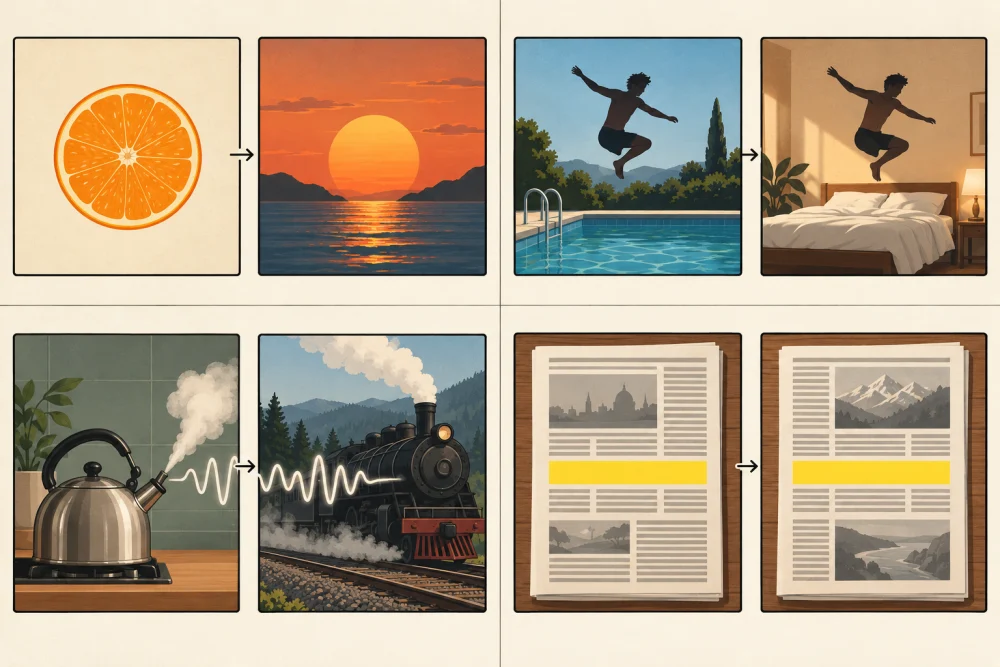
In film editing, most cuts simply move you to the next useful shot. A match cut does something extra: it repeats an element from the outgoing shot in the incoming shot. A round object becomes another round object. A hand reaching left continues as a different hand reaching left. A scream turns into a train whistle.
Because your attention is locked on that repeated element, you accept the change of place or time instantly. That is why match cuts in film can cover huge distances, sometimes millions of years, in a single frame change.
Why editors use match cuts
Editors reach for a match cut for three main reasons:
- Continuity. A matching action hides the cut, so a scene flows even when it was filmed from different angles or on different days.
- Time and place jumps. Repeating a shape or sound lets a story skip ahead without an establishing shot or a title card.
- Meaning. Putting two things side by side invites a comparison. When a primitive tool turns into a spacecraft, the edit makes an argument about progress that no character has to say out loud.
Here's the under-discussed part: a match cut is a strong signal, so it carries weight. Use one in a casual moment and viewers will look for a meaning that isn't there. Save the most obvious matches for transitions that deserve them.
The four main types of match cuts
Most match cuts in movies fall into one of four groups, depending on what the two shots share. Many great examples combine two at once.
Graphic match cut
A graphic match cut repeats a shape, color, line or composition. The subject usually changes completely while the form stays in the same part of the frame: a wheel becomes a clock face, an eye becomes a planet. Graphic matches are the easiest to spot and the most likely to carry symbolism.
Action (movement) match cut
An action match cut, often called a match on action, continues a movement across two shots. A character starts opening a door in a wide shot and finishes the motion in a close-up. Everyday editing uses this constantly to make cuts invisible. Creative editors push it further by continuing the movement into an entirely different scene.
Sound match cut
A sound match cut links two shots through audio. A sound at the end of one shot is answered by a similar sound in the next, or a sentence started in one scene is finished in another. Because sound reaches you slightly before you process the new image, this type can feel especially fluid.
Text (typographic) match cut
A text match cut keeps a word or phrase in the same position while everything around it changes: pages, fonts, layouts or backgrounds. It grew popular in title sequences, music videos and short-form social clips, where a single word can anchor a fast montage. If you want to see this style in detail, our guide to what a text match cut is breaks it down, and you can build one in your browser with our free text match cut generator.
Match cut vs. match dissolve vs. jump cut
These three terms get mixed up, and the difference matters when you describe or plan an edit.
| Technique | How the shots change | What connects them | Typical feeling |
|---|---|---|---|
| Match cut | Instant switch on one frame | A shared shape, motion, sound or word | Sharp, surprising, connected |
| Match dissolve | The images overlap for a moment | A shared element visible during the overlap | Smooth, dreamy, reflective |
| Jump cut | Instant switch within the same scene | Little or nothing; the jump is the point | Abrupt, energetic, restless |
A match dissolve uses the same matching logic, but the overlap lets you see both images at once, which softens the jump. Several examples below are dissolves. People still call them match cuts in casual conversation, so it helps to know which is which.
11 famous match cuts in movies
These examples of match cuts are widely taught in film courses and cited by editors. Each entry names what is being matched.
- Un Chien Andalou (1929). A thin cloud passes across the moon, followed by a razor slicing across an eye. A graphic match on a horizontal line crossing a circle, built to shock.
- The 39 Steps (1935). A woman discovers a body and screams, and the scream becomes the shriek of a train whistle. A classic sound match that also moves the story to the next location.
- Citizen Kane (1941). Charles Foster Kane's guardian wishes young Charles a "Merry Christmas," and in the next shot, years later, he finishes the line with "and a Happy New Year." A dialogue (sound) match that skips years in one edit.
- North by Northwest (1959). The film ends as Roger pulls Eve up into a sleeper berth, then cuts to a train rushing into a tunnel. A playful graphic and symbolic match.
- Psycho (1960). Water spirals down the shower drain, and the image dissolves to the dead eye of Marion Crane. A graphic match dissolve between two circles.
- Lawrence of Arabia (1962). Lawrence blows out a match, and the film cuts straight to the sun rising over the desert. Light, color and a sharp breath of sound tie the shots together.
- The Graduate (1967). Benjamin pushes himself up onto a raft in his parents' pool and lands on top of Mrs. Robinson in a hotel bed. An action match that compresses a whole summer.
- 2001: A Space Odyssey (1968). An early human ancestor throws a bone into the air, and it becomes an orbiting spacecraft. The most quoted graphic match cut, spanning millions of years in one frame.
- Apocalypse Now (1979). In the opening, the whir of a ceiling fan above Willard blends with the sound and image of helicopter rotors. Built from superimpositions and sound, it links the hotel room to the war in his head.
- Raiders of the Lost Ark (1981). The Paramount logo mountain dissolves into a real mountain peak in the jungle. A graphic match dissolve that later Indiana Jones films repeated with other shapes.
- Titanic (1997). Shots of the wreck on the ocean floor dissolve into the ship as it looked in 1912, matching camera position and framing. Match dissolves that move between two timelines.
Notice that only some of these are hard cuts. Psycho, Raiders and Titanic use dissolves, and Apocalypse Now layers images and sound. What unites them is the matching idea, not the mechanics of the transition.
How to plan a match cut for your own edit
You can't usually find a strong match cut by accident in the edit. Plan it before you shoot or design it:
- Pick the shared element first. Decide whether you're matching a shape, a movement, a sound or a word, then build both shots around it.
- Lock position and scale. The matched element should sit in the same part of the frame at a similar size. Even a small offset makes the cut feel like a mistake.
- Keep screen direction consistent. If an object moves left to right in the first shot, it should keep moving left to right after the cut.
- Cut on the peak. Action matches work best mid-motion, when the movement is fastest, because the eye is busy tracking rather than inspecting.
- Let sound lead. Bringing the next shot's audio in a few frames early (a J-cut) makes many matches feel smoother.
For short-form video, a text match cut is the quickest version to make, because you control the layout instead of hunting for matching footage. A 9:16 clip of 4 seconds with a single anchored word is enough for a strong opening hook, and the step-by-step text match cut tutorial shows the pacing settings that keep the word readable.
Frequently asked questions about match cuts
What is a match cut in simple terms?
A match cut is an edit where two different shots share something, such as a shape, a movement, a sound or a word, placed so the transition feels connected. Your attention follows the shared element across the cut, so you accept a big jump in time or place without confusion.
What is the most famous match cut?
The bone-to-spacecraft cut in Stanley Kubrick's 2001: A Space Odyssey (1968) is the most frequently cited. A bone thrown into the air becomes an orbiting craft, jumping millions of years in one frame while comparing an early tool with advanced technology.
Is a match cut the same as a transition?
A match cut is one kind of transition, but most transitions are not match cuts. Ordinary cuts, wipes and fades simply move between shots. A match cut specifically repeats an element across the edit, and that repetition is what creates continuity or meaning.
What is the difference between a match cut and a jump cut?
A match cut connects two different shots through a shared element so the change feels smooth. A jump cut removes a slice of time within the same shot or angle, so the subject seems to jump. Match cuts hide or justify the edit; jump cuts deliberately draw attention to it.
Can you make a match cut without filming?
Yes. Graphic and text match cuts can be built from designed frames. A text match cut keeps one word fixed while layouts change around it, which you can create from typed text alone and export as a short video clip for your edit.